

Summary
Johnsonburg Mill builds skills from within through its Precision Maintenance on Demand training program. This article highlights how PMoD works and why it’s important to ensure essential maintenance experience passes from one team to the next.
- Training program lasts five days.
- Participants explore 26 learning modules, 30 hours of video material and hands-on practical training.
- PMoD is replacing experience lost as employees retire and preventing gaps in future workforce skills.
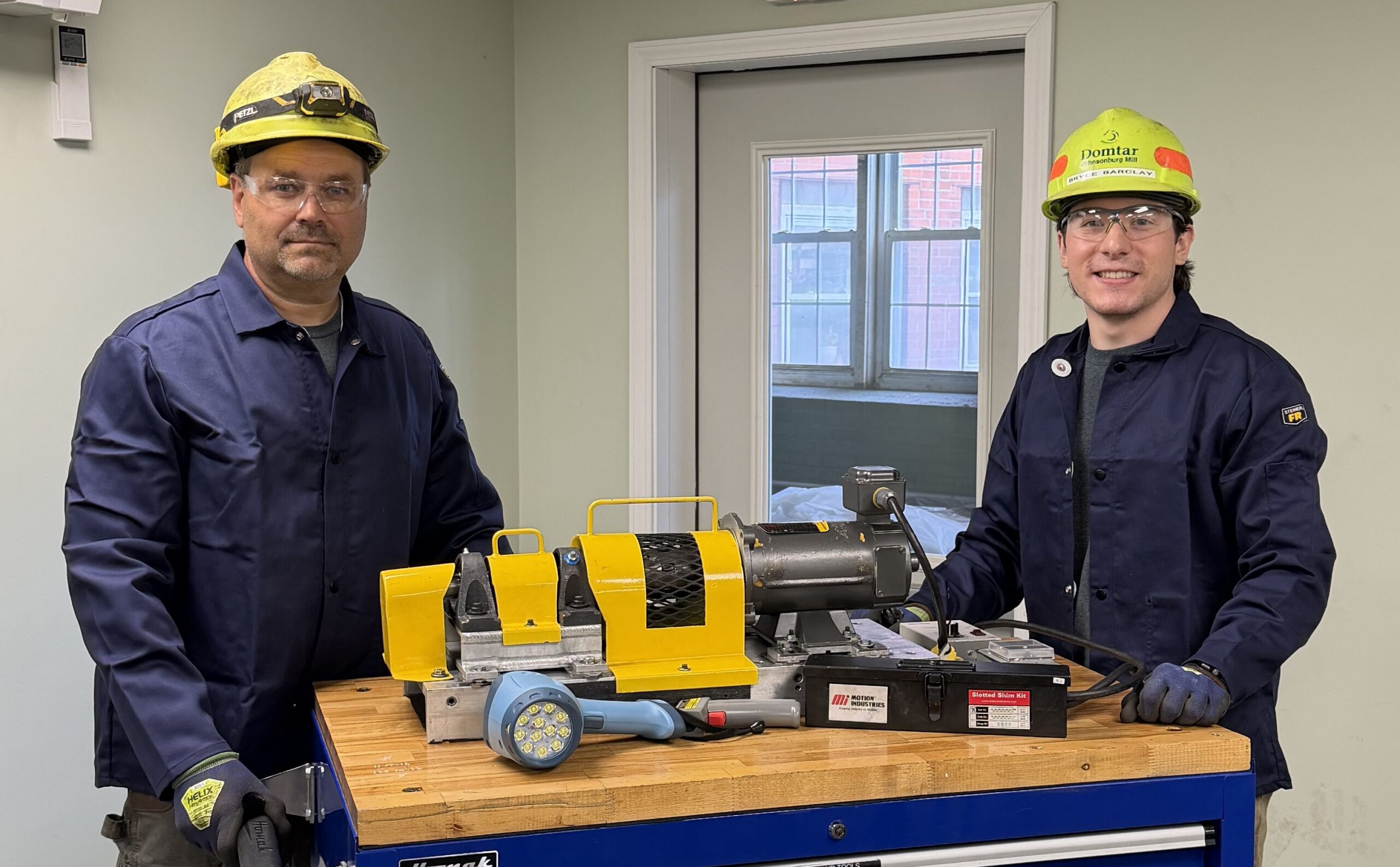
At Domtar’s Johnsonburg Mill in Johnsonburg, Pennsylvania, Dan Morgan and Bryce Barclay are helping employees rethink equipment maintenance through a new training program called Precision Maintenance on Demand.
As the mill’s reliability specialist, Dan spends much of his time troubleshooting equipment problems across the mill, drawing on years of hands-on maintenance experience. Bryce, a mechanical engineer who has transitioned into a maintenance supervisor role, brings a complementary technical perspective.
Their approach goes beyond repairing a machine after it fails. The goal is to return equipment to what they call a “precision state,” operating as efficiently and reliably as possible.
“Equipment is going to fail at some point,” Dan and Bryce explain. Maintenance teams can’t prevent every failure, but they can control how equipment is installed, aligned, monitored and maintained throughout its life.
That philosophy is at the heart of Precision Maintenance on Demand, an employee-driven training initiative designed to build maintenance skills within Johnsonburg’s pulp and paper mill.
Building Skills as the Workforce Changes
Between 2014 and 2024, Johnsonburg held 10 week-long Essential Craft Skills courses delivered by an external training provider, eventually training its entire maintenance workforce.
However, since 2024, 44 maintenance employees have retired or left for other opportunities — more than half of the mill’s fully staffed hourly maintenance workforce of 83 employees. When experienced mechanics leave, the mill loses more than employees. It can also lose years of practical knowledge.
Dan saw an opportunity to address that challenge after attending a leadership development course. He wondered whether Johnsonburg could bring more training in-house and adapt it to the mill’s people, equipment and maintenance needs.
In 2024, he presented the idea to the maintenance leadership team. With a new generation of employees entering the workforce, leaders recognized the need to develop their skills and supported the proposal.
Dan and Bryce completed instructor training, helped refine the curriculum and developed an approach for rolling Precision Maintenance on Demand (also called PMoD) out across the mill’s departments.
Learning Precision Maintenance by Doing It
Precision Maintenance on Demand combines self-paced learning with something Dan and Bryce consider essential: hands-on experience. The program includes 26 precision maintenance modules, approximately 30 hours of video material and practical activities. Classes are intentionally small, with a handful of maintenance employees working with two trainers during a five-day course.
Participants practice proper torque and lubrication, correct soft foot and perform laser alignment. They take readings before and during the work, monitoring vibration, temperature, amperage, RPM and noise.
This allows employees to see the difference precision maintenance can make. They can observe vibration levels drop as problems are corrected and see how proper alignment affects machine performance.
Dan and Bryce also provide equipment with known problems and challenge participants to diagnose the issue, identify potential failure signs and determine how to improve the equipment.
The objective is to develop mechanics who understand what precision maintenance looks like — not just how to repair equipment after it fails.
Training Designed for Johnsonburg Mill
Bringing the program inside the mill gives Dan and Bryce flexibility that outside training cannot provide as easily.
They know the employees taking the course and understand their experience levels. Because they work at Johnsonburg Mill, they can connect the curriculum to the equipment, maintenance practices and situations employees encounter every day.
Participants also learn from trainers they know and work alongside. That familiarity makes employees more comfortable asking questions and helps both newer and experienced mechanics take useful lessons from the program.
For a mill experiencing significant workforce turnover, Precision Maintenance on Demand provides another important benefit: knowledge transfer. Rather than allowing valuable maintenance experience to disappear as veteran employees retire, the program creates a structured way to pass precision maintenance practices to the employees who will maintain Johnsonburg Mill’s equipment in the years ahead.
Investing in Reliability by Investing in People
For Dan and Bryce, the program comes back to a simple principle: Precision maintenance is not only about responding when something breaks; it’s also about doing the work precisely enough to give equipment the best opportunity to perform safely and reliably for as long as possible.
What began with an hourly employee asking whether Johnsonburg Mill could do something differently has become part of the mill’s broader reliability strategy - building the skills of its people today to help keep its equipment running reliably tomorrow.