

Summary
At Domtar’s Saint-Félicien sawmill and kraft pulp mill, employees are driving continuous improvement through innovative, practical solutions. From improving sawing accuracy to reducing workplace noise, these initiatives demonstrate how employee expertise and collaboration can enhance operations and the work environment.
At Domtar, continuous improvement is a company-wide commitment, reinforced through initiatives such as the annual Continuous Excellence conference, which brings together teams from across the organization to share ideas and best practices. Recently, two projects demonstrated how this commitment translates into practical solutions that contribute to operational excellence.
In the Saint-Félicien region of Quebec, Domtar teams have turned employee-generated ideas into concrete improvements. At the sawmill, data from existing equipment allows operators to track sawing accuracy more quickly. At the kraft pulp mill, a muffler designed and manufactured on site dampens noise that was disrupting employees’ daily routine.
The projects were carried out at two separate facilities with different processes and needs, but they illustrate the same approach: putting continuous improvement into practice by relying on local teams’ expertise to find solutions adapted to their workplace.
Improved Monitoring of Sawing Accuracy at the Sawmill
At the Saint-Félicien sawmill, the precision of the cutting tools directly affects the quality of the wood produced. A slight variation in the width of a piece of wood can cause losses later in the process, especially during planning.
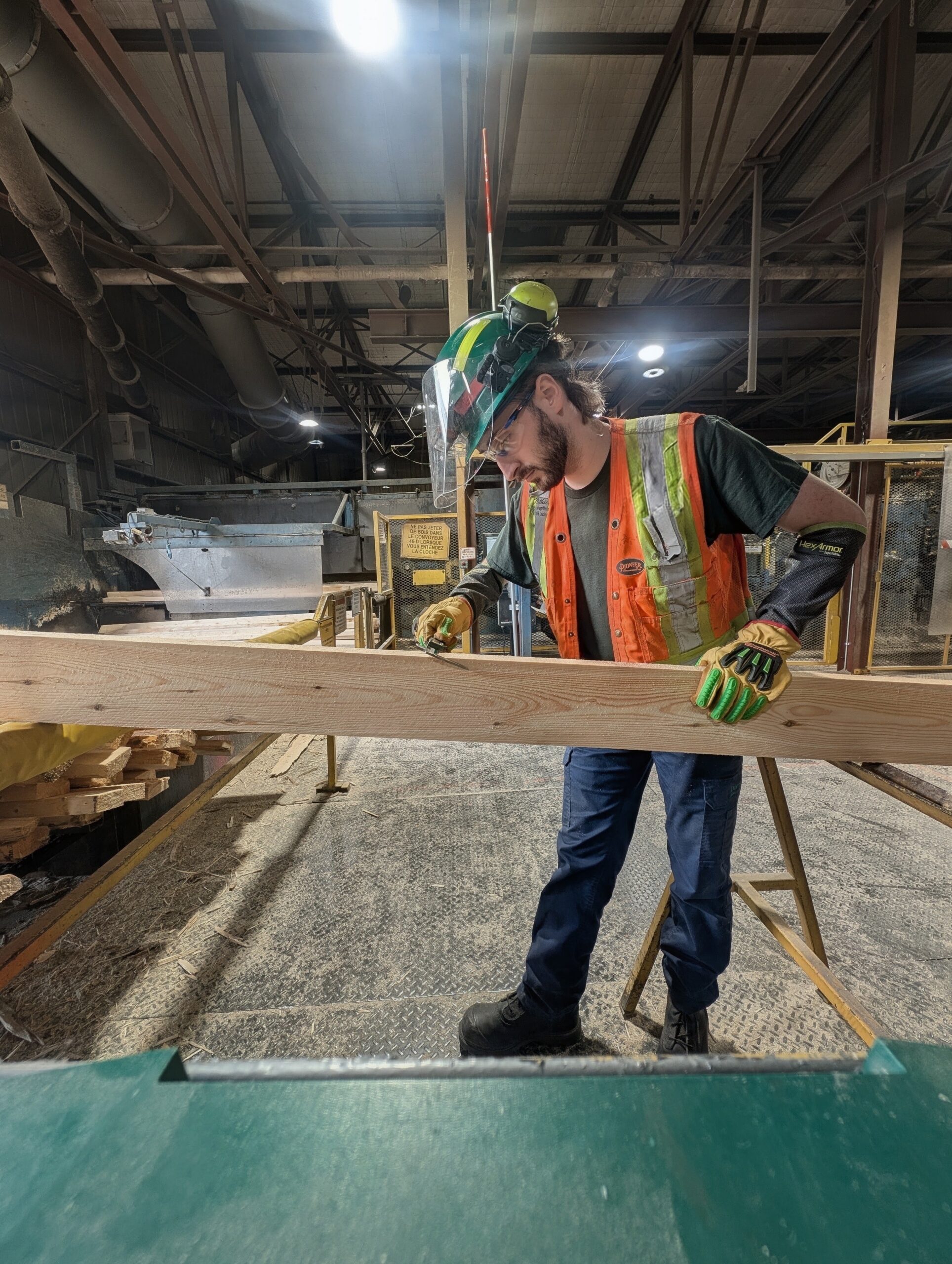
Before the team completed this continuous improvement project, an employee would retrieve pieces of wood and measure them with a caliper, usually every two hours. The operator, working more than 120 feet from the measuring station, had no immediate visibility into the dimensions of the lumber he had just produced.
“Previously, the operator had to adjust the machines according to information received from the employee doing manual measurements," explains Sawmill Superintendent Erika Blackburn.
Mathieu Douchain, supervisor, sawmill optimization and quality, came up with the idea of using an optimizer installed at the end of 2023 to position the wood before it entered the stationary saws. The equipment already generated highly accurate measurements of squared timber. Working with Éric Minier, a chief electrician with more than 20 years of experience at Domtar, and other colleagues, Mathieu set about making the data useful to operators.
Thanks to a recent upgrade of the sawmill’s automation systems, the team could extract, store and analyze measurements, and then match them to the right cutting patterns and tools. Using tests, calibrations and comparisons with physical measurements, the team developed a solution from resources already on site.
“The information now appears directly on the operator’s control screen. An alarm sounds when the measurements exceed the acceptable range. The operator can then adjust the saws or squaring heads and see the effect more quickly. Manual controls are still in place as a second check,” Mathieu explains.
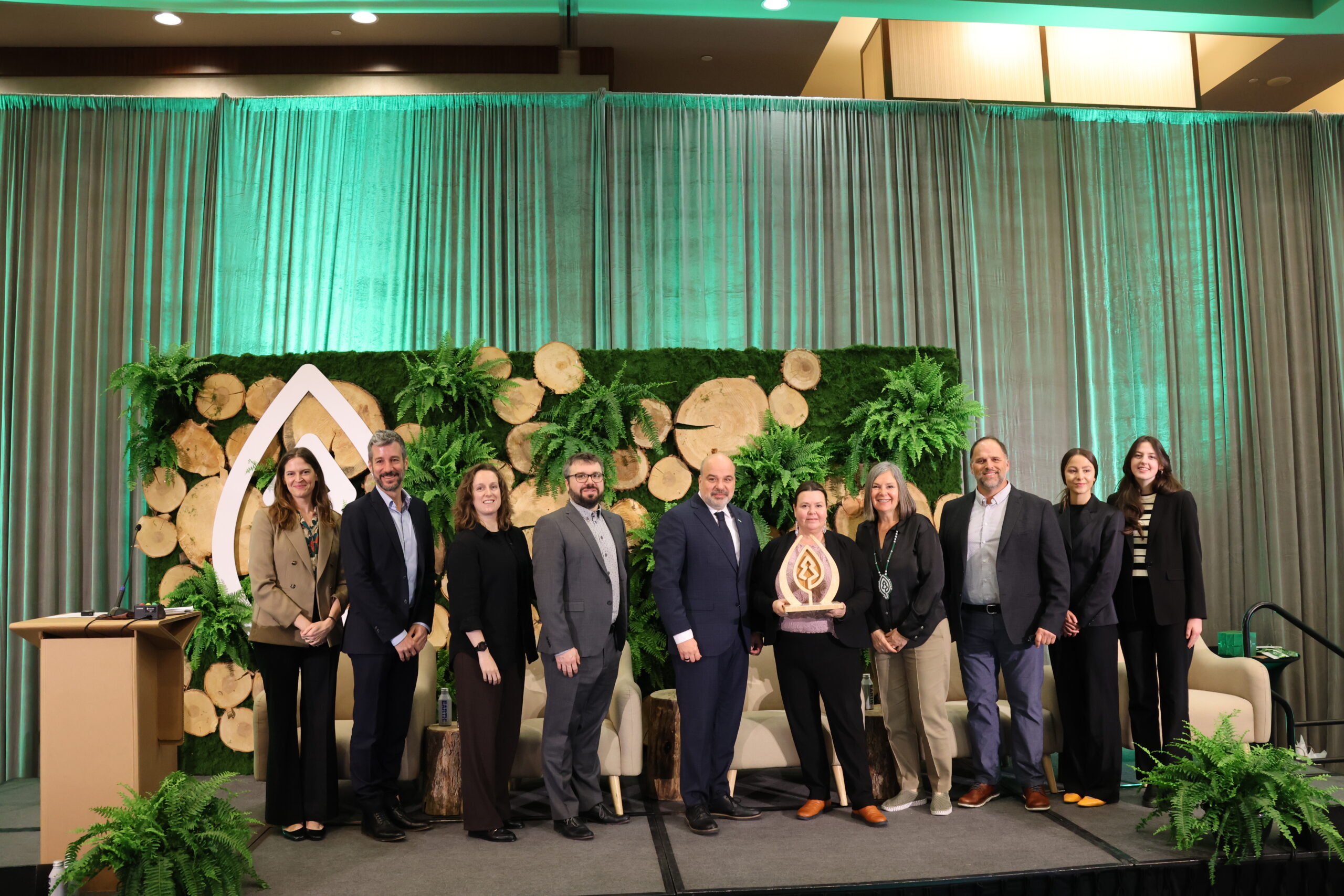
This continuous improvement project contributes to more uniform quality and higher output. It was recognized at Domtar’s Continuous Excellence Conference and could be extended to other production lines. Mathieu also received Top 10 Under 40 recognition from Opérations Forestières. (Learn about other emerging leaders at Domtar.)
Reducing Noise at the Kraft Pulp Mill
The Saint-Félicien kraft pulp mill had quite a different need. A fan on the pulp machine produced a continuous, high-pitched whistling near the area where pulp sheets are cut, stacked and baled before shipping.
Packaging takes place nonstop, and the noise was constant in the surrounding areas: the shift mechanic’s shop, the operators’ laboratory and the lunchroom. Even closed double doors weren’t enough to dampen it.
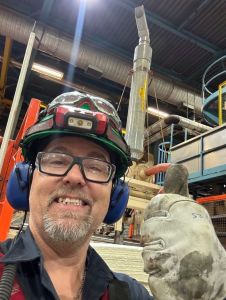
Carl Gosselin, mechanical planner, helped Trottier order the materials, and Michel Lemieux, health and safety superintendent, endorsed the initiative. Trottier then assembled the muffler between his other duties during his shifts, creating a solid piece of equipment that can be easily accessed for maintenance.
This continuous improvement investment, which cost far less than a commercial solution, made an immediate difference. Even though the team didn’t take before-and-after sound measurements, employees in the vicinity find the noise reduction very noticeable. Even so, hearing protection equipment is still required in the production area.
“This project shows that a simple, well-thought-out solution can make a real difference. It solved a concrete problem and improved the work environment. It’s a win-win for everyone,” says Marie-Noëlle Watts, manager of the Saint-Félicien kraft mill.
The project was submitted to Domtar’s annual Continuous Excellence Conference in the Employee Ideas category and highlights the importance of supporting employee creativity, especially when it comes to continuous improvement.
“We want to recognize people who take the initiative. Carl Trottier saw a problem, he talked to the right people about it, and the team trusted him to develop his solution,” explains Marie-Noëlle.
From quality monitoring at the sawmill to noise abatement at the kraft mill, these two initiatives show how a culture of continuous improvement, driven by employee ideas and collaboration, can advance operations and improve teams’ daily lives.