

Summary
What happens when a mill’s primary paper machine needs an essential repair that is potentially months away? At Domtar’s Dolbeau Mill in Quebec’s Lac-Saint-Jean region, members of the engineering, maintenance and operations teams put their heads together and came up with an innovative solution that sets an example for other mills to follow.
In late May 2026, the mill’s maintenance teams were preparing to carry out scheduled maintenance on paper machine No. 5. During an inspection, however, they discovered concerning cracks in one of its rolls.
The teams decided to remove the roll for a more thorough inspection, and what they found confirmed their concerns. The damage extended to the inside of the roll, meaning it could no longer be operated safely.
That would be a challenge for any mill to overcome. But paper machine No. 5 is at the heart of Dolbeau Mill, which produces approximately 100 different grades of paper, including book paper and newsprint.
Fortunately, the mill had already ordered a replacement roll well before it discovered the cracks. But this type of specialized equipment requires a long manufacturing lead time, and delivery was still several months away.
Three Options, One Goal: Restart Production
Dolbeau’s maintenance teams considered three possible solutions: Repair the damaged roll, expedite delivery of the new one or find a used roll that could be adapted to the machine.
They quickly ruled out the first option. Due to the roll’s metallurgy and the extent of the damage, repairing it was not possible.
The teams then explored whether the manufacturer of the new roll could accelerate production. Even with a significantly shortened lead time, however, they would still have to wait several weeks to receive and install it before restarting the machine.
That left the most complex option: finding a compatible roll elsewhere. Because paper machine No. 5 has unique characteristics, the chances of finding an exact replacement were slim. What if, instead of searching for an identical roll, they could find one that was close enough and adapt it?
A Race Against the Clock
The search quickly took on an international dimension. Companies from Brazil, Austria and elsewhere around the world responded to the mill’s call for bids. The Dolbeau teams considered every possibility with the same objective: Find a solution that would allow production to resume as quickly as possible.
After an extensive search, they located a used roll in the United States. Its diameter met the machine’s requirements, but it was narrower than the original roll.
That discovery marked the beginning of a major engineering effort involving Domtar teams and several Quebec-based partners.
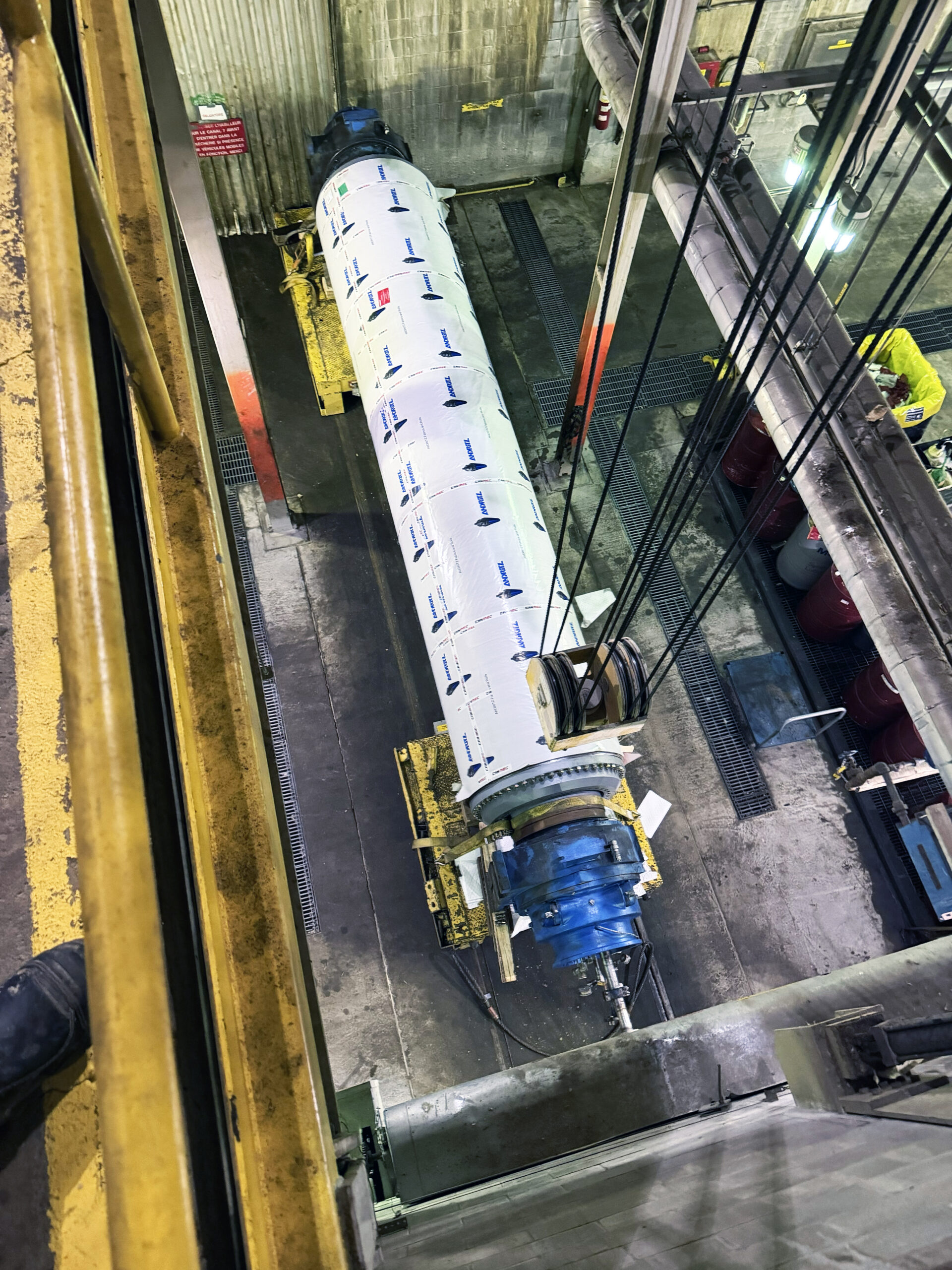
The roll was sent to CANMEC in La Baie for inspection and modification. With support from engineering firm Simu-K, the teams used 3D modeling and finite element analysis to determine how the roll could be integrated into the existing machine.
Modifying the roll itself was only part of the challenge. The teams had to adapt several components to ensure the entire assembly could be safely and reliably integrated into paper machine No. 5.
While that work was underway, the Dolbeau teams prepared everything they could in advance. Once the roll reached the mill, every hour would count.
“It was far from a sure thing, installing a roll that had been modified and wasn’t the original roll. There were no guarantees,” says Jean-Michel Simard, mill manager at Dolbeau Mill.
A Solution Built Together
The modified roll arrived in Dolbeau on July 1, and the mill’s engineering, maintenance and operations teams immediately went to work. Thanks to the extensive preparation and close coordination across different technical teams, the mill installed the roll in approximately 12 hours. During the night of July 1 to 2, paper machine No. 5 restarted, and it began producing paper on the first attempt.
Behind that achievement stood several weeks of research, calculations, modeling, preparation and collaboration among people with a wide range of technical expertise. A solution that had seemed improbable only weeks earlier allowed the mill to resume operations well before the new roll arrived.
The new roll will be installed on September 22. The adapted roll can then be inspected and retained as a backup for future needs.
For Youri Simard-Boulianne, engineering superintendent at Dolbeau Mill, the experience offers a lesson that can be shared with teams at other Domtar facilities facing similar challenges.
“Don’t give up. The solution will come,” he says. “You must believe in it and give it your all. In our case, the solution was built like a tower, with everyone adding their own brick. Looking back now at everything we accomplished, it’s simply fascinating.”
The collaboration also extended well beyond the teams at Dolbeau Mill. Colleagues from other Domtar facilities contributed their expertise and networks throughout the project.
More Than a Machine
The restart also served as a reminder of the important role Dolbeau Mill plays in its community.
During the shutdown, interest in the situation extended well beyond the mill’s gates. Employees, partners, local businesses and community members closely followed the efforts to restart production. That support takes on particular significance for a century-old mill that has been part of the economic and social fabric of Dolbeau-Mistassini for generations.
The story of the paper machine No. 5 roll is about much more than an equipment breakdown. It is the story of teams that, faced with a problem without an obvious solution, chose to search, adapt and collaborate. Most importantly, they found a way to get the machine running again.
Dolbeau Mill’s innovative solution reflects Domtar’s history of creative problem-solving, including: