

Summary
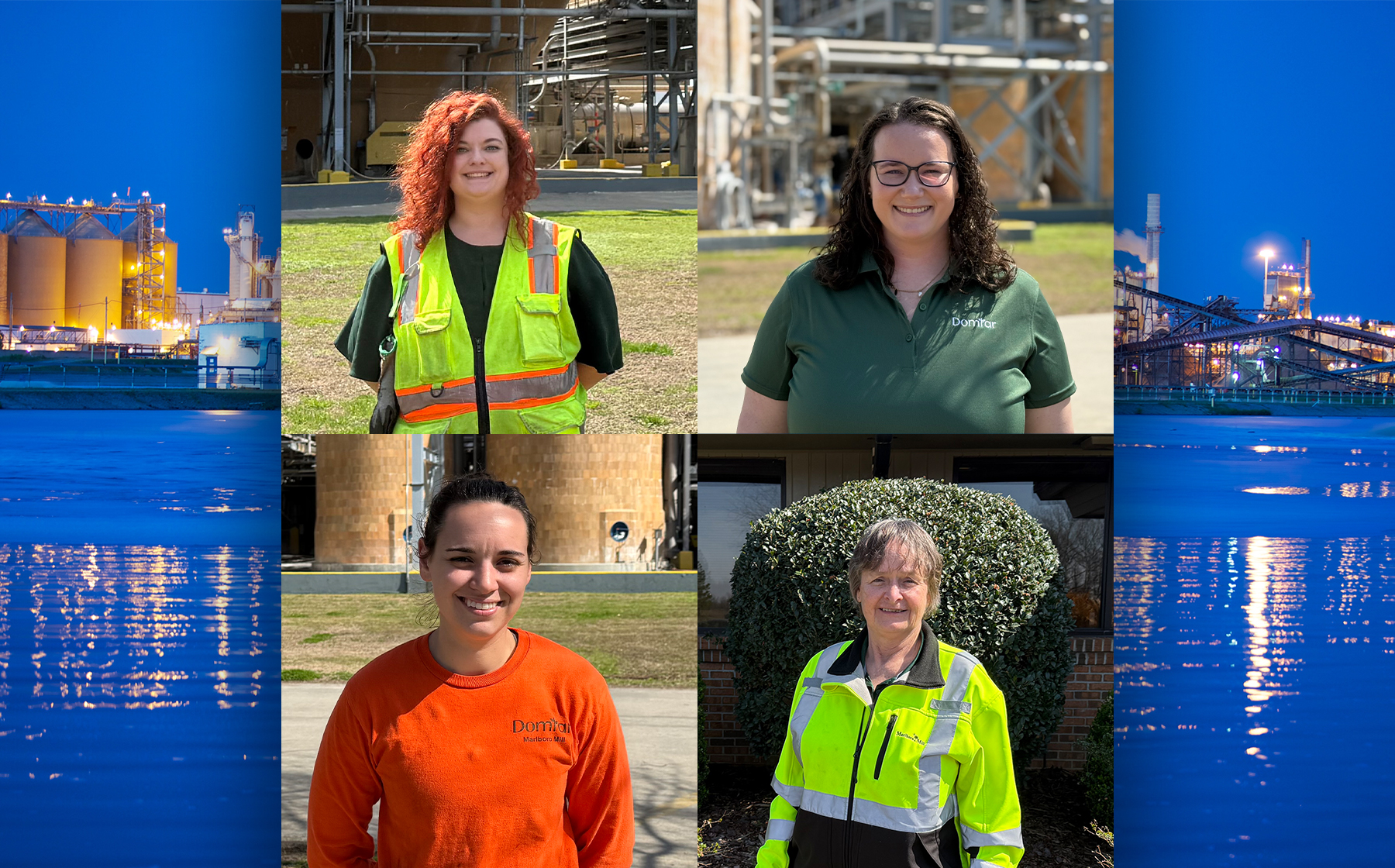
Several incredible women leaders have chosen to build their Domtar careers at our Marlboro mill. Meet:
• Abby Hayden, quality manager
• Emily Butcher, environmental engineer
• Athena Strickland, technical services manager
• Traclynne Allison, forester
For Women’s History Month, they share what brought them to Domtar and the focus areas for their roles, and they walk us through a typical day in their working life. They also give advice to themselves 10 years ago.
Domtar’s Marlboro mill in Bennettsville, South Carolina, makes rolls of lightweight paper that are converted to our Clarion® point-of-sale branded paper, lightweight thermal paper used to print transaction information, like printed receipts and labels. Today, we are North America’s only integrated supplier of phenol‑free POS paper. Our Marlboro mill also manufactures lightweight papers used in everyday products such as lottery tickets, copy paper and tablet paper.
Several incredible women leaders have chosen the Marlboro mill as the place to build their Domtar careers, including Abigail (Abby) Hayden, quality manager; Emily Butcher, environmental engineer; Athena Strickland, technical services manager; and Traclynne Allison, forester.
In honor of Women’s History Month, read on to learn more about their experiences as women leaders at Domtar and get a glimpse of a day in their lives.
What brought you to Domtar?
Abby (pictured top left): I had finished my freshman year and was home for the summer. I got a random phone call from Domtar saying an intern had dropped out, and they needed a co‑op student for the fall. One of the career counselors at NC State had recommended me. It was one of those moments where you just say yes, and it ends up changing the direction of your life.
I came out [to Marlboro] for a fall semester and really loved it. They kept inviting me to return, so I ended up doing three co-ops. I later did another co-op somewhere else just to make sure I wasn’t choosing Domtar simply because it was the only place I’d worked. It turns out I genuinely liked this place. Then Domtar reached out about interviewing for a full-time role. But it all began with that random phone call one summer afternoon.
Emily (pictured top right): I have family members who work in the paper industry, so when I went to NC State engineering, I considered joining the Paper Science and Engineering program. After my freshman year as an engineering undecided major, I wanted an internship to help me decide if that field was right for me, so I did a summer internship at the Plymouth mill. I fell in love with the process, and the people there were wonderful. They taught me a lot and helped confirm that I was on the right path.
Athena (pictured bottom right): I’ve been here for 36 years. When I first came, the mill wasn’t even fully built yet. I was about a year and a half out of school and wanted to move back to the greater Bennettsville, South Carolina, area. Back then, Domtar held pre‑employment classes. I was in the second class of the year, training for a Recovery & Utilities role. The mill pulled me into environmental work early on. At first, it was just me and the manager. The group built up from there. Over the years, I worked my way up through different roles within technical services. After all these years, I’ve seen the mill grow from the very beginning to what it is now.
Traclynne (pictured bottom left): I got bit by the Domtar bug when I was about twelve. There’s a satellite chip mill in New Hill, North Carolina, that feeds this mill. Growing up, my neighbor worked as the forester for that chip mill, and his dad was the logger. I’d watch the equipment heading up and down the road. One day I asked him what it was for, and he said, “Come work with me one day.” I spent the whole day with him in the woods, seeing how trees were harvested and how the wood eventually made its way to the mill. I briefly considered being a teacher, but ultimately, I knew I belonged outdoors in the woods and working in forestry. Now that I’m part of it, there’s no driving me away. It’s fun, and it’s different every single day.
What are the main areas of focus for your role?
Abby: I handle anything related to quality, like product quality, testing, customer satisfaction and troubleshooting issues. Sometimes that’s helping determine where a problem comes from. It’s very investigative, almost like detective work. I also look at product formulation to make sure we meet customer expectations, and I work on process improvements. Really, assisting our customers in any way they need. And, if you visit the Marlboro mill, I might be leading your tour!
Emily: I’m an environmental engineer with a focus on air. That means I monitor what comes out of our stacks and make sure we comply with all the environmental regulations. We operate under an air operating permit issued by the state, and a big part of my job is making sure we meet every requirement in that permit. I also do a lot of work in our manufacturing data analytics software, Parcview. When you're out in the mill, everything — temperatures, pressures, levels — is monitored, and that data gets stored in Parcview. I started using it as a co-op student, ended up being the only person utilizing it, and eventually became the go‑to person. Now I help create graphics and tools so people can use the data in practical ways.
Athena: I lead the environmental team, and our focus is on keeping the mill in compliance. That includes monitoring and reporting to state agencies, making sure we meet all requirements for air, water and waste, as well as radiation safety and a handful of other programs. A big part of our work is translating regulations into clear, simple instructions for the people who operate the mill. My goal is always to make things understandable without overwhelming anyone. We also do process testing and monitoring, and our environmental lab supports those efforts.
Traclynne: As a forester, chip quality is my #1 priority. It has a huge impact on how well the paper machines run, so I spend a lot of time in the chip mill doing safety audits, walking the yard, listening to equipment and checking conditions. This industry still runs on old‑school relationships, and a handshake and face‑to‑face conversation go a long way. Loggers don’t want an email; they want you to show up. Maintaining strong, respectful relationships with them matters just as much as chip quality. We help ensure that loggers follow best practices to meet third-party certification requirements. It’s part of making sure we’re sourcing fiber responsibly. I also do a lot of learning. Even after almost seven years in this role, there’s always something new to pick up.
What does a typical day in the life like for you as women leaders?
Abby: I’m not a morning person, but I have an hourlong commute, so I wake up around 5 a.m. to get my 2-year-old daughter and me ready to leave the house by 6:15. Some mornings are easy, some aren’t, depending on her mood (and mine). When I get in to work, I review how the previous day went. We have meetings with operations and maintenance to review what happened on the machines. After that, I meet with my team, the two people who help manage everything, to discuss priorities, issues and anything needing attention for the day.
The rest of the day varies. I might troubleshoot lab equipment or join customer meetings. We also meet regularly with other Domtar mills to share cross-functional issues and learn from each other. After work, I will either go work out with my personal trainer or go pick up my daughter from daycare. Once we get home, I will play with her while my husband cooks dinner, and I’ll clean the dishes afterward. We always do family dinner together. Then it’s bath time and bedtime for her, and downtime for us. I go to bed early, around 9 p.m.
Emily: Most mornings start with my one‑year‑old waking me up. He just turned one in January, and my daughter just turned three. Getting everyone ready for daycare and work is hectic, but once I’m here, we start a morning meeting with our technical services group, which includes environmental engineers and the lab team. Environment touches every part of the mill, so we really have to look at everything. Right now, a big part of my job is preparing for our new air operating permit and figuring out how we’ll comply with it alongside other departments. It’s also reporting season, so I’m calculating and reporting all emissions from the mill. From there, it’s a pretty normal rhythm: lunch with coworkers, then wrapping up whatever projects are on my plate. After work, it’s back to the wonderful chaos of having young kids. I prioritize spending time with my kids and my husband while managing the evening routine. When I have the time, I enjoy sewing for stress relief. I work nine hours Monday through Thursday, and then a half day on Friday. That Friday afternoon time is precious for that small window of me‑time.
Athena: These days, my kids are grown, so my mornings are quieter. I usually wake up around 5:30 a.m. The first thing I do is check my email to see what happened overnight or if anyone needs something. After that, I get ready and decide whether there’s time for coffee at home or if I’ll wait until I get to work. My drive takes about 40 minutes. I almost always listen to audiobooks. When I arrive, we start with a staff meeting. The team gets the environmental information ready: key metrics, operational updates and anything that needs our attention. We talk about what’s happening in each area, such as air, water and waste, and talk through safety topics. We’re not looking to police anything; we’re looking for things the shift might not recognize as an environmental concern but that we need to follow up on. I eat lunch here and usually leave around five. After work, I stop to visit my dad. He lives close to me, so I check on him daily. After that, I head home. It makes for a full day, but a good one.
Traclynne: I have a ton of energy, so I go work out first thing. Even at the gym, my phone rings: loggers, contractors, truck drivers. I don’t mind it. I’d rather they call and ask questions than make a decision that creates problems later. Once I get to the mill, I walk around the chip mill making sure everything looks and sounds right — checking equipment sounds, making sure everyone has on their personal protective equipment and checking the quality of the first load off the chipper. After that, I head into the office. A lot of people need things from me in the mornings, so that usually carries me through until lunchtime. After lunch, I’m in the woods until the end of the day. I meet with loggers, check tracts, walk boundary lines and review best practices. I might drive 40–60 miles out, depending on where our logging crews are that day. Many tracts around here are family‑owned, and the crews always make time to talk. They care deeply about the work they do, and relationships are everything. I’m a landowner myself now because my husband and I bought thirty acres. Instead of a big engagement ring, what I wanted most was land. Around 5 p.m. I’m usually heading home. We’re building a house on our land. In the evenings, I spend a lot of time at the fire station. I’m a volunteer firefighter, and my husband is a deputy chief. It’s a whole second job in a way, but I love it.
As successful women leaders today, what do you wish you knew 10 years ago about your life now?
Abby: Go with the flow. I’ve struggled with anxiety about whether I’m making the “right” choice or doing something that matters. I’d tell myself to make peace with decisions. You don’t need to make the perfect choice; just make the best choice for the moment. It’s also such a different perspective being a freshman in college — the ramen‑noodles-and-broke stage — compared with having a stable career. Long-term planning is hard at that age.
Emily: Ten years ago, I was in college doing a co-op here in the Recovery and Utilities department. That experience was very rewarding, and afterward I wanted to be a process engineer in the Recovery and Utilities department for the rest of my career. That ended up being my first job here after college, and I loved the process. But what I’d tell myself is that it’s okay for your plans to change. I never imagined I’d be in an environmental role, but it turned out to be the best career move I could have made. It gives me a reliable schedule, and I still get to do a lot of problem‑solving. It wasn’t the path I expected, but it has worked out really well for me. So, I’d tell myself: Be open to change.
Athena: Ten years ago, my son was 13 and my daughter was 20. Life was busy then, but not drastically different. In terms of work, I was already in this same department and in a leadership role, just under a different manager. If I could tell myself or my kids anything from back then, it would be not to worry so much about the future. My son, especially, stressed a lot about growing up, and I wish I could have told him not to. Things have a way of working out.
Traclynne: I would have laughed at myself! When I graduated, I knew I wanted to be in the industry, but being hired straight into procurement is rare. Most people need years of experience first. When a longtime forester was retiring, the job opened, and I asked if I should apply. They interviewed several people but ultimately decided to consider college grads. The interview panel included the team I’d eventually join, and I didn’t realize at the time how important it is to have a strong team around you — a leader who trusts you, coworkers who support you and a group that truly works together. The job is one thing. But the people you work with every single day make all the difference. I’m lucky. I have a great team here, and I wouldn’t trade them for anything.