

Does product packaging matter to consumers? Yes, according to the 2025 Two Sides Trend Tracker 2025 Consumer Survey. Study participants, who also weighed in on their environmental perceptions of paper, their preferences for printed materials and their use of tissue products, overwhelmingly prefer paper packaging over other materials like glass, metal and plastic. That’s great news for the paper industry — including Domtar, a leading manufacturer of 100% recycled containerboard that is used for paper packaging.
Jules Van Sant is executive director of Two Sides North America, a non-profit organization whose members span the graphic communications paper-based packaging value chain, including pulp and paper manufacturers like Domtar. Its mission is to share consistent and verifiable messaging that demonstrates the uniquely sustainable benefits of forest products. She says the packaging data from this year’s report shows how North American consumer perceptions are shifting when it comes to paper packaging.
“During the COVID-19 pandemic, consumers relied heavily on online ordering. With so many people receiving boxes and packaging, they became more aware of the paper aspect of packaging and began recognizing that it’s more sustainable than other options,” says Van Sant. “Paper can be easily recycled, boxes can be reused, and the raw materials are renewable and sustainable. But there’s still more work to be done to change consumer perceptions about paper’s impact on our forests and how often it can be recycled.”
Paper Packaging Is Appealing
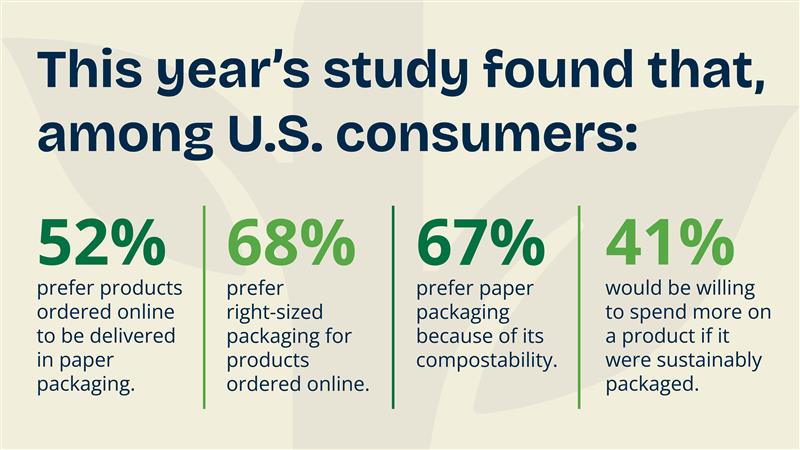
This year’s study found that, among U.S. consumers:
- 52 percent prefer products ordered online to be delivered in paper packaging.
- 68 percent prefer right-sized packaging for products ordered online.
- 67 percent prefer paper packaging because of its compostability. Other factors include paper’s lower environmental impact (49 percent) and ease of recycling (46 percent) as compared to plastic, glass and metal.
- 41 percent would be willing to spend more on a product if it were sustainably packaged
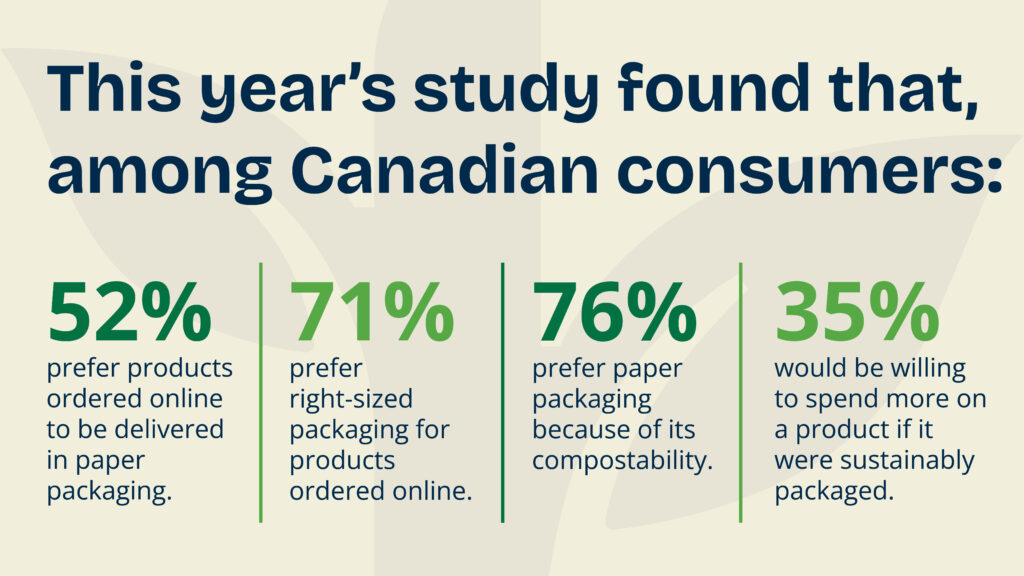
Canadian consumers show even stronger preference for paper packaging, with consumers citing paper’s compostability (76 percent), ease of recycling (59 percent) and lower environmental impact (57 percent) as factors. And 71 percent expressed a preference for right-sized packaging for online purchases. More than half prefer online purchases be shipped in paper packaging, but they are 6 percent less likely than their American counterparts to spend more on a product just because it is packaged using sustainable materials.
Generational Preferences Persist
Age also played a role in the survey results:
- Consumers aged 65 and up are 31 percent more likely to recycle paper-based packaging after use than consumers age 18-24.
- Younger consumers are more likely to avoid retailers if they aren’t actively trying to reduce their use of non-recyclable packaging, with those age 25-34 outpacing other age groups at 46 percent.
- Older consumers (age 65+) show the greatest demand (86 percent) for right-sized packaging, nearly double those age 18-24 (45 percent).
- All age groups are receptive to the idea that non-recyclable packaging should be discouraged through taxation, with the greatest agreement among consumers age 25-34 (56 percent) and age 35-44 (53 percent).
“We also found that the younger generation, the 18-24 year olds, are gravitating toward paper in other areas of their lives,” says Van Sant. “They’re digital natives, but now they’re saying, ‘I don’t want everything digital.’ They understand that paper is recyclable, and it supports environmental stewardship. It will be interesting to see how that will impact their demand for paper packaging in the future.”
Still Room for Improvement
Perhaps surprisingly, the survey found that consumers still don’t fully understand the environmental impact of paper and paper packaging.
While the majority of North American consumers believe it’s important to use paper products from sustainably managed forests, more than half of study participants still believe that U.S. and Canadian forests are shrinking. In reality:
- U.S. forest area increased by more than 18 million acres between 2005 and 2020.
- Canadian forest area remained stable between 1990 and 2022.
That growth and stability come in spite of a thriving North American forest products industry. That’s because manufacturers like Domtar understand that sustainable forestry is not only good for our business and our customers, but it also benefits our neighbors and our planet.
Awareness is also still lacking when it comes to paper recycling. Most consumers understand that paper and paper packaging can be recycled, but when asked about recycling rates in the United States and Canada:
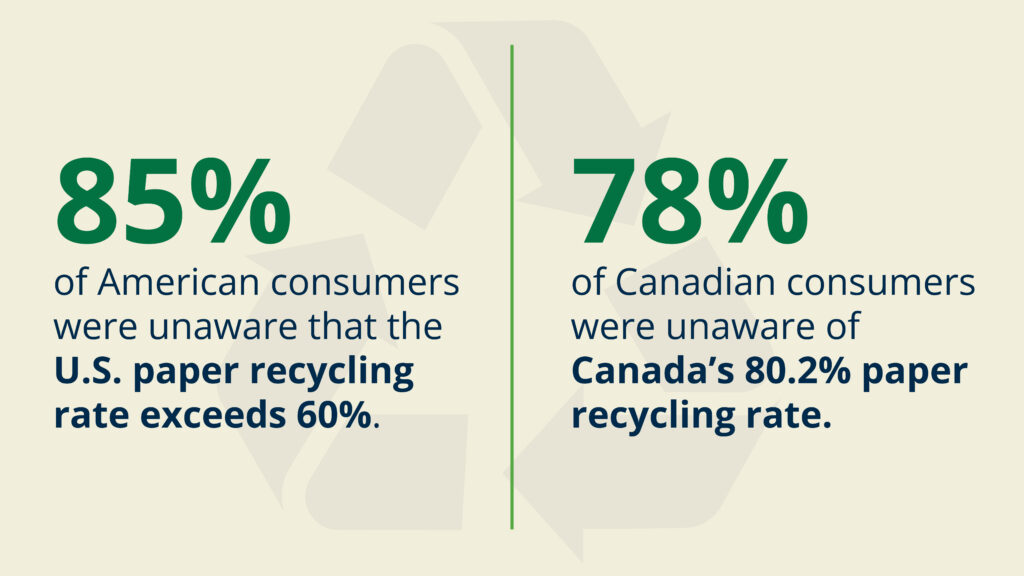
- 85 percent of American consumers were unaware that the U.S. paper recycling rate exceeds 60 percent.
- 78 percent of Canadian consumers were unaware of Canada’s 80.2 percent paper recycling rate.
“There’s still work to be done to educate consumers that paper is the most sustainably produced, recycled and reused medium for packaging,” says Van Sant. “But there’s also consumer appetite for more sustainable packaging and manufacturing.”
That creates an opportunity for paper packaging, not just for manufacturing and shipping but also as it relates to a product’s brand story.
“Product manufacturers can use paper packaging as part of their sustainability story,” says Van Sant. “Digital fatigue is real, so this is a great time for printed product inserts, manuals and brochures. Paper packaging is also more accessible, especially for older consumers or those with physical limitations who can’t easily open a plastic package or access digital instruction manuals.”
Learn more about consumer preferences for paper packaging and other trends by downloading Two Sides Trend Tracker 2025.