




When budgets tighten, print and mail are the first places to be cut. But what if small, intentional changes could reduce your costs without sacrificing results?
For the Fall & Winter 2025 edition of Paper Matters, Editor-in-Chief Meredith Collins decided to put one commonly discussed theory to the test: can reducing the weight of paper used in the magazine help lower mailing costs?
Setting the Margins
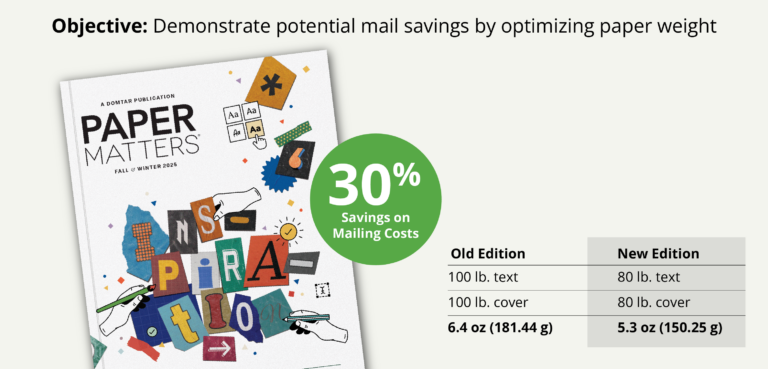
Historically, Paper Matters has been printed on 100 lb. Text and 100 lb. Cover, alternating between Cougar® Smooth and Lynx®. For this edition, we made a deliberate shift to Cougar 80 lb. Text and 80 lb. Cover in a Super Smooth finish.
While the basis weight was lighter, the paper still delivered a refined, luxurious tactile experience. Paper Matters is created for creatives, complete with a vibrant cover and bold spreads, so we couldn’t afford a loss in image quality. Fortunately, we knew what sheet we needed to produce crisp lines and bring rich solids into focus. In fact, Cougar Super Smooth—something we hadn’t used for Paper Matters in quite some time—proved that lighter weight doesn’t have to mean lesser quality. The silky finish of Cougar® Super Smooth enhances the impression of any printed piece and with high opacity and 98 brightness, the visuals popped off the page.
Paper choice wasn’t the only lever we pulled. We also took a closer look at list management, which doesn’t always require reinventing the wheel. In this case, the solution was as simple as removing duplicate records and incomplete addresses and accepting that returns are simply part of the mailing process.
To support ongoing list hygiene, we’ve begun including a contact update form in the engagement emails sent alongside each issue of Paper Matters. This allows our mailing list to improve continuously over time without adding strain to internal teams.
Right-Sizing the Savings
From a print perspective, the cost savings associated with offset printing alone was relatively modest. We also examined how many magazines were being printed versus how many were actually used. By reducing the print quantity by 20%, we avoided excess inventory and achieved approximately 10% in print savings.
The biggest impact came from mailing costs. The combination of reduced basis weight and improved list accuracy resulted in approximately 30% savings on postage.
That’s a meaningful reduction, especially for mail programs that run multiple times per year.
So What's the Takeaway?
Print and mail continue to be powerful engagement tools, even when budgets are constrained. This exercise showed that small, thoughtful adjustments—from paper selection to list management—can unlock significant savings without compromising the experience your audience receives.
Smart choices don’t have to be dramatic to be effective. Sometimes, it’s the subtle shifts that deliver the biggest results.